
Emma Moss Brender has a Master’s in Creative Writing from Concordia University. Her work has been published in Headlight Anthology. She lives on the unceded Indigenous lands of Tiohtià:ke/Montréal.
“This sequence applies a theory of syntax called X-bar to Robert Hayden’s famous poem ‘Those Winter Sundays’ (1966). It is part of a project exploring how insights in linguistics that grew out of Noam Chomsky’s generative grammar can contribute to literary criticism; and, beyond criticism, how diagramming the structure of sentences can help us get at hidden emotional resonances and conceive of other kinds of human structures in a new way.
“The diagram pictured here is my rendering of Hayden’s poem in what linguists call sentence trees. I also refer to Stephen Watkins Clark’s A Practical Grammar: In Which Words, Phrases, and Sentences Are Classified According to Their Offices, and Their Various Relations to One Another : Illustrated by a Complete System of Diagrams (1863).
“The final poem is what ‘Those Winter Sundays’ would sound like if you were to read the ends of each branch of the X-bar diagram, moving top to bottom and left to right. This reading voices parts of the sentence that you don’t normally hear, including all the null elements, tense phrases, and traces of words that have moved to different positions.”
Throughout my childhood, my mother, an architect, went to the office. Then she came home from the office, and after she came home, she would often sit at her drafting table drafting the plans for houses and other buildings. Sentences, too, have an architecture. Over the years, grammarians and, later, linguists, proposed different ways to characterize and represent that architecture. The sentence diagram has at times been drawn as a series of boxes nested within a bigger box, a cluster of contiguous bubbles, or a rhizome of connected lines. One syntactic theory, called generative grammar, produces trees that grow downward at a diagonal, with phrases at the main junctions and words hanging from the tips of the branches.
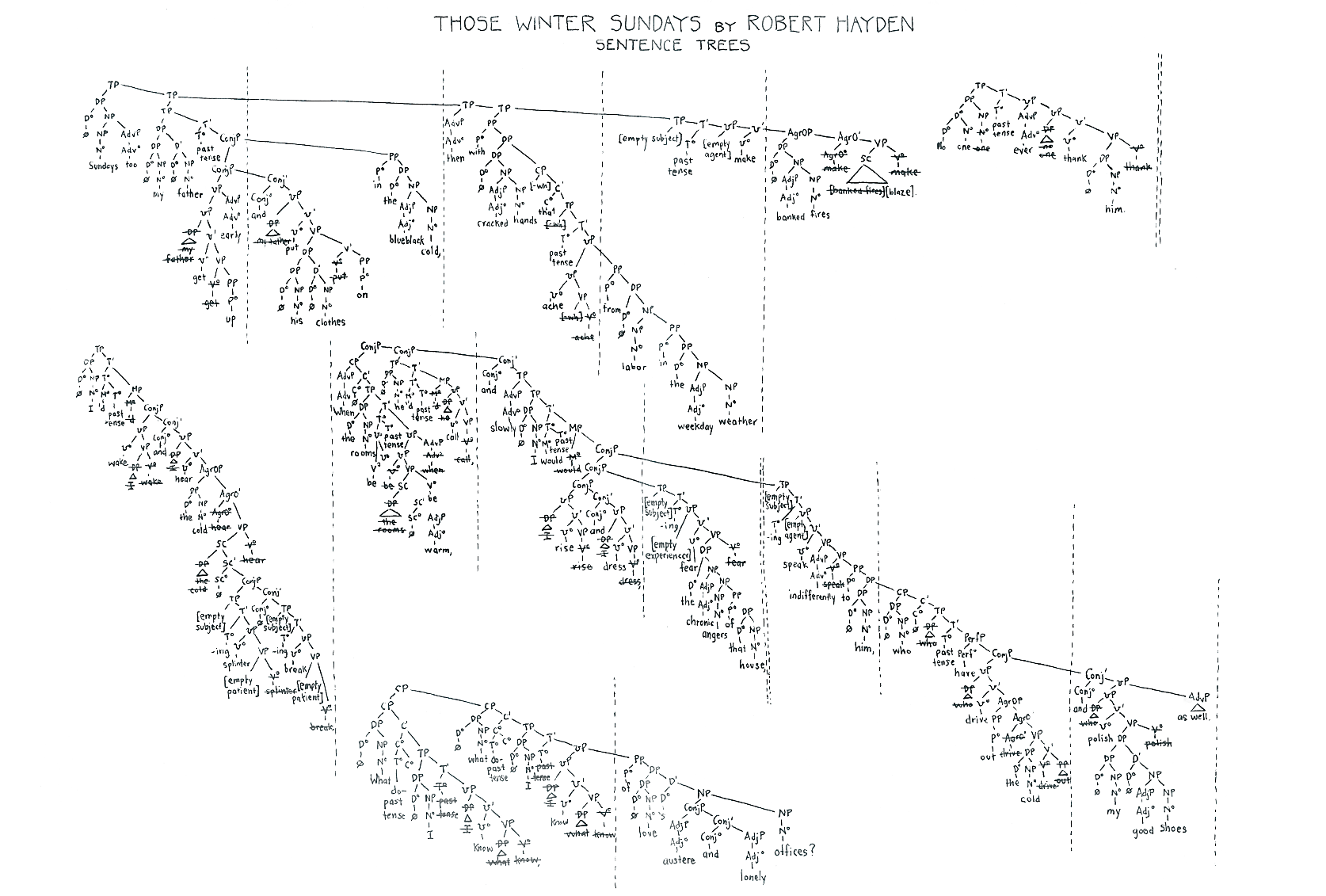
Generative grammar proposed that every sentence is the outcome of a hidden process of revision, in which words move from one location to another. Linguists distinguished between the deep structure of a sentence—its initial order—and the surface structure—its final arrangement. But how deep was deep? At first, the sentence seemed content to shed its earlier versions once all its parts had found their proper places. But the deep structure refused erasure: linguists found they couldn’t adequately describe how the sentence worked without it. The solution, then, was to represent both together: the tree would illustrate the words before they moved with a strikethrough and then again after they moved without one. These words (and other sentence elements) could move several times, leaving their traces behind at every stop before finally coming to rest. The tree, then, would be a record of transformation.
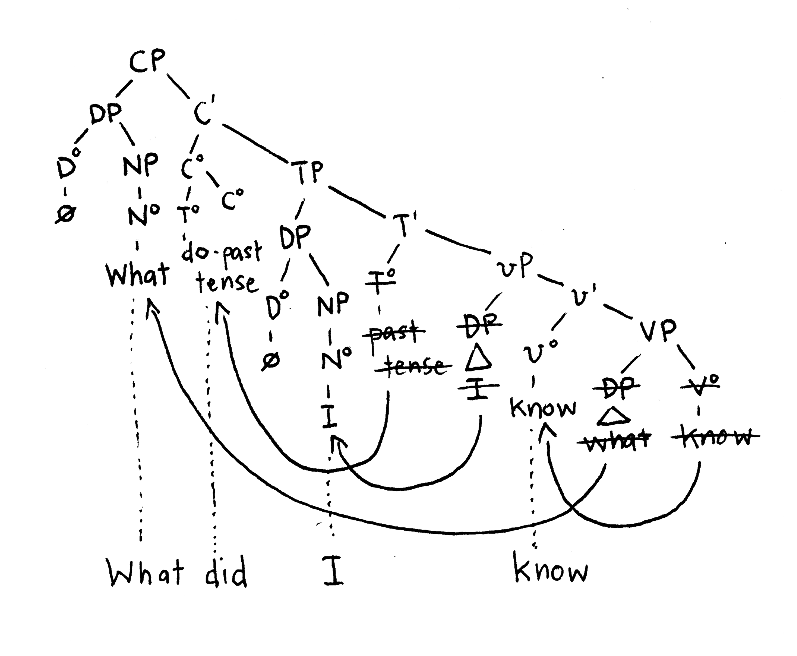
Stephen Watkins Clark introduced one of the first systematic methods for diagramming English sentences in his 1847 book, A Practical Grammar. In it, he explains, “The office of an Element in a Sentence, determines its position in the Diagram.” Office. An odd word. Even odder in a sonnet, and odder still as an ending.
What did I know, what did I know
of love’s austere and lonely offices?
Offices? It comes as a question inside a question, a dawning inside a dawning. This domestic poem that seems to be about family life, about fathers and sons, about love, turns out to be about not knowing, and then, finally, about work. Looking back, we might have noticed the changes. While the father “got up” and “put his clothes on,” the son “would rise and dress.” They carry out the same actions, but in separate registers. Offices. Clark invokes the word frequently in A Practical Grammar to mean a role, a function. More than that, an office is a ritual, a rite, a calling. A compulsion. A necessity. An office is also a set of walls, half-walls, dividers, lines drawn on the ground, the suggestion of an enclosure. In what ways are these walls freeing or confining? What do they enable, what do they suppress? What do they reveal, what do they hide?
“Those Winter Sundays” by Robert Hayden
A sentence tree reading
Null Sundays too null
my null father
past tense my father
get get up early and my father
put null his null clothes put on
in the blueblack cold,
then with null cracked hands
wh– that wh– past tense ache
wh– ache from null labor
in the weekday weather
empty subject past tense empty
agent make null banked fires
make banked fires blaze make.
No one one past tense ever
no one thank null him thank.
Null I’d past tense ‘d wake
I wake and I hear the cold
hear the cold null empty subject
-ing splinter empty patient
splinter, null empty subject -ing
break empty patient break hear.
When null the rooms be past
tense be the rooms null warm
be when, null he’d past tense ‘d
he call call, and slowly null I
would past tense would I
rise rise and I dress
dress, empty subject -ing empty
experiencer fear the chronic
angers of that house fear,
empty subject -ing empty
agent speak indifferently
speak to null him, null who
null who past tense have
who drive out drive the cold
drive out and who polish
null my null good shoes
polish as well. Null what do
past tense null I past tense
I know what know, null
what do past tense null I
past tense I know what know
of null love ’s austere
and lonely offices?